Wednesday, 13 February 2013

Lighting Tutorials

In the lead up to the 3rd progress presentation, I've been doing a few lighting tutorials to improve my skills in that respect, since one of the things the lecturers picked up on in my last presentation was that I needed to spend more time developing my technical skills and bringing my lighting and texturing skills up to scratch.
Ryan lent me the Advanced Maya Lighting and Texturing book by Lee Lanier so I tried a tutorial he suggested from that to see how it went.


These are some screencaps from the finished scene. I followed the tutorial step by step but the LightFog attribute didn't work when I rendered it, as there is supposed to be a stream of light flowing in from the window, casting a shadow of the shape of the window on the floor. I am unsure if this is because I rendered in mentalray when the tutorial instructed to render in MayaSoftware. I had to render with mentalray because my laptop displayed error messages when attempting to render with maya software and wouldn't complete the render. I tried to see if this was related to an unloaded plug-in but has no success. I will attempt to fix this using the uni computers and then re-install maya on my laptop as it is pretty buggy and tends to crash a lot more than is normal.
The shadows in this scene are also quite crisp and clean cut when they should be a lot softer due to the candlelight lanterns used as light sources. Again, I followed the settings step by step and rendered in mental ray as opposed to MayaSoftware and as this is the only difference I can think of, I'll try tweaking the settings and rendering on one of the uni computers.


In addition to this tutorial I also created a small dining room scene. I used similar settings as I did in the first tutorial from the book Ryan lent me, and tried to get more comfortable with texturing with bump and normal maps to enhance the look of the dining room table, floor and walls etc. I also made a glass shader which looked great when viewed from some angles but from others it made the inside of the glasses appear black.


The LightFog effect again didn't work, and instead created a grainy effect outside the window that looked like a blizzard. The light emmited from the sportlight shining through the window in an attempt to simulate moonlight is too harsh and has clearly defined edges. Similarly the shadows again need to be softer as they have hard edges despite the soft light being emitted from the candles and ceiling lights.


As stated previously, I will attempt to render these scenes out again in MayaSoftware in uni, other than that I'll try and tweak some settings to see if it makes a difference in mentalray. I can't spend too much time on it though as I want to get started on some more media tests involving a short series of vignettes, which will recycle the same assets with small additions and tweaks to create new stories in the same scenes.

Friday, 8 February 2013

Critical Framework

After speaking to Ryan last week I went off and read a few project dissertations and proposals on similar research projects to help identify my critical framework criteria. I also took notes from various GDC conference presentations that I'd looked at, and drew up a list of what I thought were influencing factors in environmental narrative.

Ambient:

Colour
Lighting/Shadows
Materials/Textures
Space
*Sounds. (No sound will be used in final environment.)
Framing
Geography (Vistas)
Architecture

Narrative;

Player Created Space
Scenes, Events and Vignettes

Props;

Artefacts
Decals
Effects
Posters and Graffiti

Navigational;

Beacon
Signpost
Trail

I'll be using this framework criteria to analyse scenes in games to see how effectively they can be used in conveying narrative.

Compiled the info into a mind map to make it a bit clearer:


Tuesday, 5 February 2013

Supervisor Meeting

So I met up with Ryan on Friday and spoke about some of the issues I was having with my project, one of the main ones being that I wasn't actually sure where I was heading with the final piece of my project.

After a good discussion Ryan helped me narrow down what I could do with my final piece and I'm feeling much calmer about it all. We agreed on a few action points that I would complete as milestones before this Friday 8th Feb.

1) Work through a tutorial in the Advanced Texture and Lighting book Ryan lent me, and try out 3-4 different lighting setups and comment on what the lighting says in terms of the narrative effect.

2) Refine the Project Aim and decide whether or not to keep the characterisation element within the environment (as I had previously focused on showing character through the environment, but Ryan suggested that this was more to do with personification rather than environmental narrative.)

3) Have a go at further defining the Critical Framework by identifying the criteria for analysis in Environmental Narrative

We also had a discussion about what my final project piece could be and I'm currently playing with the idea of designing 4 different rooms, each intent on conveying a different mood/atmosphere, utilizing the techniques of narrative storytelling. This could involve experimenting with animated lighting, so I'm going to be looking for tutorials on that in the book and online.

Tuesday, 15 January 2013

Using Light to Indicate Areas of Interest....

As stated in my previous post, using light as a method of visual sign posting is extremely effective. So I though I'd use it in my scene as more that just a means of lighting up the room, but to show specific areas and evoke a certain mood.


Clearly, this attempt didn't go down to well. The light was far too harsh and extreme. The contrast between lit and unlit areas was far too great.


Second attempt went down a bit better with the addition of two floor lamps and using spotlights. It cast long looming shadows, which I liked because looming shadows are supposed to indicate a feeling of unease, and as Topher's work raises some severe moral dilemmas (though maybe not for him) I found this quite fitting. However, the rest of the room is pitch dark apart from one area in the back right corner where I added a point light to break it up a bit and show that the TV was a source of light. This didn't have the effect I was after as it just looked strange because the TV screen was still dark, but the surrounding area was lit...


Next attempt definitely illuminated the room...but it's far too bright for just two spot lamps which are pointed in a specific direction...
Also I increased the irridiance on the TV screen in attempt to make it seem brighter as a source of light in the background but it ended up too bright and looked odd.


AO. Included another lamp over by the dresser area as another source of light.

Lmap on dresser has two point lights inside, one that casts light and shadows, and the other which only casts light. I like this more, although the long looming shadows by the desk are lessened majorly...
Going to have to trawl through some more tutorials and experiment with global and caustic illumination and try out photons to get the effect I'm after. Also have to include more light sources.

Thursday, 10 January 2013

Visual Sign Posting in Games

A technique many games make good use of, is visual sign-posting. A notable example being Journey from ThatGameCompany. The game begins without context in which the only apparent objective is to approach the large mountain on the horizon which has a bright light atop it. The use of light to highlight areas of interest in games in highly effective.


This subtly suggests to the player that this is the direction in which the must proceed. Simple sign posting such as this makes the player feel as though they are exploring the game world based on their instincts and their own choices, as opposed to the designers intention. Mysterious ruins scattered throughout the desert landscape provide hints at the back-story of the game.


Mirror's edge, though an older game, makes good use of the colour red to define the intended path to the player. It indicates objects which can be climbed/run over etc. Though a clear path, such obvious visual sign posting as this can have the effect of making the player continuously aware that they are playing a game, as climbable objects in real life are not simply all the same colour. It can even reinforce to the player all the current constraints that the game imposes on their play, and furthermore, makes them at all times aware that they are following an intended path. Journey's approach to visual sign posting felt much more natural. A slight breeze pointing you in the right direction, whereas Mirror's Edge's approach is more like a sharp prod.


Dear Esther, from Thechineseroom received much critical acclaim due to its innovative approch to environmental storytelling and have even been the spark of yet another debate about what constitutes a game, and whether or not games are art. The lead artist, Robert Briscoe spoke at the 2012 Game Developers Conference about adding history to the environment through the implementation of details such as old shipwrecks, to build a past and not just a present, and stated that this helps to define the reality of the game world.


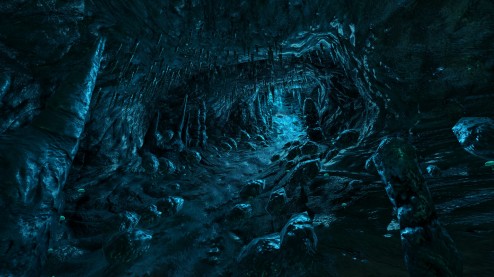
Both Journey and Dear Esther use this technique excellently in that the implications of a time long past is soft and subtle enough not to remove the player from the game. Light was important in Dear Esther, as it was in Journey. Especially in the caves, the light represented a path to follow, furthered by the glowing patterns and writing on the walls.


Thursday, 3 January 2013

Game Environment Analysis - Houses in Heavy Rain

Embedding Narrative in an Environment


Designers use a technique known as "embedding" to place symbolically influential props/objects in the environment as an alternate means of storytelling, meaning they don't have to rely on flashbacks and cut-scenes as much. Quantic Dream's Heavy Rain (2010) makes good use of this technique. The plot of the game revolves around a father, Ethan Mars, whose youngest son Shawn is presumed to have been kidnapped by a serial killer known as the "Origami Killer". At the beginning of the game, the player assumes the role of Ethan Mars before any of these events have taken place. By exploring Ethan's house, the player can learn a lot about his personality and his current lifestyle. Books on architecture and bridges can be found all over his house, which indicates his interests and possibly his job.


Props, Textures, Colour and Lighting. 


In his bedroom there is a note left on the floor from someone we presume to be his partner, but by examining the photo (fig1) on the dresser of Ethan's bedroom the player learns that it is his wife. The bunk beds (fig 2) in the room next door indicate that Ethan has a young family and possibly two children. Ethan's house is large, bright and colorful which are all indications of a friendly and happy environment. The area downstairs(fig 3) in the house is quite quirky and features an open plan raised seating area with pillars/columns. This suggests to the player that Ethan is quite wealthy and due to the information already gleaned from the books around his house that he may have in fact designed the house himself. This idea is further solidified when the player inspects the office downstairs and discovers that Ethan is in fact an architect.

Left, (fig 1) Wedding Photo. Right, (fig 2) Bunk beds.

(fig 3) Downstiars 

(fig 4) Garden


The back garden (fig 4) of Ethans house is very spacious, neat and well cared for. There is also a colourful child's play area complete with climbing frame and chute, which again tells the player that Ethan has children who are happy and well looked after.


This bright and happy living environment starkly contrasts with the house Ethan later lives in two years after one of his sons Jason is killed in a car accident (fig 5). This house is much darker, and has a lot more neutral colours and tones in comparison to the bright and colourful hues in his previous house. The textures on many of the surfaces such as the peeling wallpaper and poorly conditioned wooden door frames are dingy and make the props look like they are old and decaying. There are cardboard boxes (fig 6) all over the house which tells the player Ethan has only just moved in and away from the previously happy family home, or that he hasn't bothered to unpack yet, which is an indication to the player of his lack of motivation and depressed state of mind. The back garden(fig 7) to this house reflects the atmosphere of depression and decay as the grass is unkempt, dead looking and patchy with muddy puddles
everywhere.

(Fig 5) Ethan's Dingy House

(Fig 6) Cardboard boxes

(Fig 7) Unkempt Back Garden


The effective use of props, colour, texture and lighting as a storytelling technique can make for a much more personal and meaningful play experience as each player brings their own thoughts and experiences to the table. In an interview with David Cage, the creator of Heavy Rain, he mentions that;

 "We really wanted the player, through his actions, to tell the story and for these actions to have consequences. We tried to do our best in the writing to have an interesting and strong proposal for gameplay and for narrative in every single scene in the game. That was challenging because we don't use mechanics, we don't use patterns in the game. What you have to do and how you are going to do it is pretty much different in every scene.

This, I feel, aptly describes their approach with Heavy Rain. The game is designed to be a personal experience with many different ways of play and choices to make, and the game environment plays a big part in this. The player may decide what objects to look at/interact with and therefore decides just how much information they will absorb from the narrative subtext implemented into the environments. This in turn leads to different plot paths and ultimately, an ending which is entirely dependent on the player's approach throughout the game, which is in turn motivated by their interpretation of the physical make-up of the environment and the props with which they interact. 


-David Cage Interview available from; http://www.fastcompany.com/1558681/heavy-rain-creator-david-cage-reveals-secrets-his-photo-realistic-serial-killer-ps3-game


Well it's been a while...

It's been longer than I'd like since my last update. This was due to project proposal madness. Finding out that the majority of my research wasn't as relevant as I thought was definitely a blow but it meant I still had some time to restructure. Now that's handed in and I just have to cross my fingers and hope that I've done everything right and expressed my project aims and research effectively without somehow managing to plagiarise someone else's work, which I'm petrified of.

I went back home for the holidays, which is another reason my posts have been stunted as my home is now an internetless void, which was a horrible Christmas surprise...

Anyway, onwards to some more work. My next post will be a compilation of game environment analysis and contrasting some of the techniques undertaken by the art teams involved in their creative approach to environmental storytelling.